Skip to content

Topics: Crises, Incident

  • Bolstering agriculturally dependent communities against climate catastrophes may prevent future violent clashes

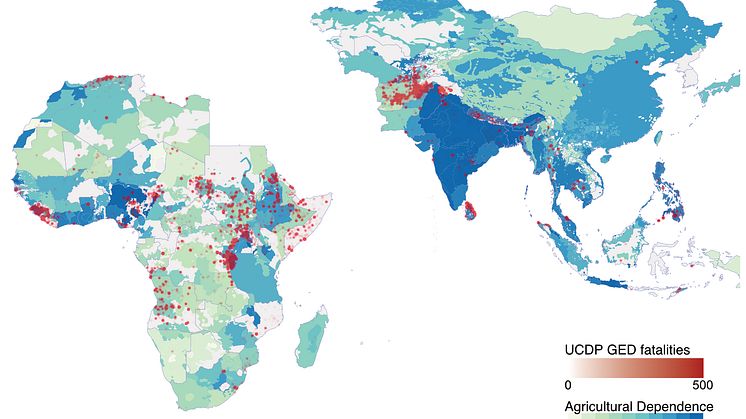
    Severe drought is associated with a higher incidence of armed conflict among agriculture-dependent populations in the least developed states. Strengthening the political status and economic well-being of these marginalised groups, can reduce the risk of conflict. This is a key finding of a study by researchers at Uppsala University and the Peace Research Institute Oslo, published in PNAS.
  • Sustainable peace is more than lack of violence

    In a world of conflict and violence new knowledge on how to build sustainable peace is urgently needed. In his dissertation PhD candidate Florian Krampe emphasizes the need for helping countries to reset their internal relations on a peaceful path.

  • Upward trend in fatalities in organized violence was broken in 2015

    The alarming upward trend in fatalities in organized violence, witnessed over the last few years, was broken in 2015. This is evident from new data from the Uppsala Conflict Data Program (UCDP), Uppsala University. The number of armed conflicts involving states continued to increase, however, going from 41 in 2014 to as many as 50 in 2015.

  • New conflict data show that 2014 was a very violent year

    In June, Uppsala Conflict Data Program (UCDP) reported that the number of fatalities in armed conflict has increased substantially in recent years, and that 2014 was the most violent year since the end of the Cold War. New data show that also the other two types of violence analyzed by the UCDP – conflict between non-state actors and violence targeting civilians – increased substantially in 2014.

  • 2014 the most violent year since the end of the Cold War

    40 armed conflicts were active in 2014, the highest number of conflicts since 1999 and an increase of 18% when compared to the 34 conflicts active in 2013. New data from the Uppsala Conflict Data Program (UCDP) shows an increase in both the number of active conflicts but also in the number of battle-related deaths in these conflicts.

  • Zennström climate professorship to Doreen Stabinsky

    ​Climate researcher Doreen Stabinsky will be Uppsala University’s first holder of the Zennström Visiting Professorship in Climate Change Leadership. She is to take up the position on February 1st and contribute to the establishment of an environment that will be unique, both in Sweden and internationally.

  • Individual metropolises now global political players

    By providing the infrastructure that connects global flows and financial systems, major cities have increased their political power alongside the nation-states. In some cases, they are pursuing their own foreign policy in several areas. In her PhD thesis Kristin Ljungkvist, at Uppsala University, has studied the effects of this development and argues that certain risks should be heeded.

  • High number of fatalities despite unchanged level of armed conflicts

    At 33, conflicts in the world last year increased by one compared to 2012. This is reported by peace researchers at Uppsala University’s Conflict Data Program. The number has remained stable over the past decade. However, 2012 saw an increase in the number of battle-related deaths and two out of five people dying in battles, died in Syria.

  • A high price to pay for cheap technology

    Rape in war cannot be addressed in isolation. It is deeply embedded in both the local context and that of global proportions. This is one of the conclusions made in a doctoral thesis about eastern Democratic Republic of Congo presented at Uppsala University on 19th September.

  • Armed conflicts decreased in 2012, but fatalities increase

    Last year the number of armed conflicts decreased markedly, at the same time as the number of battle-related deaths in these conflicts increased dramatically, largely due to the situation in Syria. This is described by peace researchers at Uppsala University’s Conflict Data Program (UCDP) in an article recently published in the Journal of Peace Research.

  • New study challenges popular beliefs about migrants from war-torn countries

    Events such as the bombing of the Boston Marathon seem to confirm people’s suspicions that migrants from war-torn countries harbor hatred resulting from experiences of trauma and displacement. In a new study from Uppsala University, Sweden, doctoral student Jonathan Hall finds, contrary to the prevailing view, that migrants may actually be more moderate than the local population after war.

  • Titanic is an Exception among Disasters at Sea

    On April 15, a century have passed since the Titanic foundered during its maiden voyage. Since then there has been a widespread belief that in a disaster, women and children will be saved first. Based on analyses of 18 of the most notable shipwrecks from the 19th century until today, researchers from Uppsala University conclude that this is a myth.

  • New data allows for unique conflict research

    Which factors increase the risk for armed conflict and war? What circumstances make conflict resolution more likely to be successful? Today, the Uppsala Conflict Data Program (UCDP) releases a new dataset which opens up new possibilities for the study of armed conflict. Using these data, useful findings relating to climate change and armed conflict have already been made.